By Scarlett Lewis, Founder and Chief Movement Officer, Choose Love Movement
We all experience anger. Kids get angry. Parents get angry. Educators get angry. I get angry. Anger isn’t something we need to eliminate, and it isn’t necessarily a “bad” emotion. Like all emotions, anger is information. It tells us something about what is happening around us and, just as importantly, how what is happening is landing within us.
Anger can tell us that a boundary has been crossed, that something feels unfair, that we’re hurt, frightened or overwhelmed, or that something important to us is being threatened. It can even provide the energy and motivation to stand up for ourselves or someone else and create positive change. The problem isn’t that we feel anger. The problem begins when anger takes control of what we do next.
As parents and educators, this is especially important. With obvious exceptions such as responding immediately to physical danger, when we react impulsively from anger, we are often not responding from our most thoughtful, regulated selves. And our children know this. They may not understand the neuroscience behind it, but they intuitively recognize when the adult in the room has lost control.
We are the leaders in our homes and classrooms. Leadership doesn’t mean never becoming angry. It means being able to experience anger without automatically handing it the steering wheel. Self-control isn’t the absence of emotion. It is the ability to feel an emotion and still choose what we do with it.
This is where the Choice Moment becomes so important.
The Choice Moment: Where We Take Back Our Power
When something triggers us, our brain and body can respond incredibly quickly. We can feel the urge to yell, punish, send the text, fire back at the email, slam the door or say something we’ll regret.
But we don’t have to act on that first impulse.
I call the space between what happens and what we do next the Choice Moment. It may only last a few seconds, but it can change everything.
How do you use the Choice Moment?
First, pause.
Then, breathe.
Slow, intentional breathing can help settle the body’s stress response. This isn’t about pretending you’re no longer angry. You’re creating enough space to make a better decision.
Then get curious.
What am I really feeling?
What’s underneath my anger?
What happened that made me feel this way?
Am I responding only to what’s happening now, or am I bringing something else into this moment?
What is within my control?
What outcome do I actually want?
And one of my favorite questions:
What would the highest and best version of myself do next?
Curiosity is powerful because it’s difficult to remain completely consumed by a reactive story while genuinely questioning that story. Pausing, breathing and becoming curious can give our higher-order thinking a better opportunity to participate in what happens next.
Now we can thoughtfully respond rather than simply react.
Don’t Hand Your Power to Anger
Your personal power isn’t controlling another person. It is maintaining control over ourselves.
Think about that during an argument. If another person’s words can automatically make you explode, who is controlling your behavior in that moment?
This matters tremendously in parenting. If we remain stuck in anger, someone else may step into the leadership vacuum, and sometimes that person is the child. The child begins determining the emotional temperature of the household because the adults are reacting to the child’s behavior rather than leading through it.
The same thing can happen in classrooms and workplaces.
A dysregulated student can dysregulate a teacher. An angry employee can trigger an angry supervisor. One person’s emotional state begins determining everyone else’s.
Someone has to interrupt that cycle.
Why not you?
You can acknowledge: I’m angry. My anger is telling me something. And I still get to decide what I do next.
That’s power!
Using the Choose Love Formula Helps In Our Choice Moment
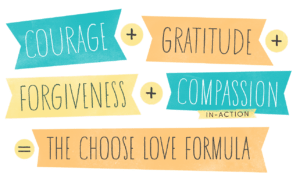
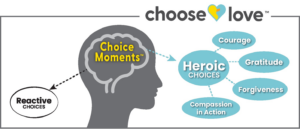
The Choose Love Formula – Courage + Gratitude + Forgiveness + Compassion-in-Action – gives us practical skills for navigating anger and other difficult emotions without surrendering our personal power to them.
Courage is what allows us to pause. Sometimes the courageous thing is not the dramatic response. It’s resisting the immediate reaction our brain is urging us to make. Courage helps us face what is really underneath our anger, have the difficult conversation, acknowledge when we’re wrong, set a healthy boundary or choose not to retaliate.
Gratitude helps us build resilience and broaden our perspective. A regular gratitude practice trains us to notice what is good even when something difficult is happening. That doesn’t mean denying hardship. It means hardship doesn’t become the only thing we can see. Over time, that perspective can support optimism and help us recover when life doesn’t go the way we hoped.
Forgiveness becomes especially important when anger is connected to something someone has done to us. There is a difference between experiencing anger in the moment and carrying anger with us for months or years. Forgiveness doesn’t mean approving of what happened or abandoning accountability. It allows us to learn and grow from hardship and, when we’re ready, begin releasing the pain rather than continually reliving it. We stop allowing another person’s actions to occupy so much space inside us.
Finally, Compassion-in-Action asks us to put love into practice. That includes compassion for ourselves. When we love and appreciate ourselves and maintain a healthy sense of self-worth, we don’t have to win every argument, retaliate against every insult or prove ourselves every time we’re challenged.
Compassion also helps us become curious about other people’s behavior. I often invite people to consider whether another person’s behavior is an act of love or a cry for love. That doesn’t mean tolerating harmful behavior. Sometimes Compassion-in-Action is a firm boundary. Sometimes it’s accountability. Sometimes it’s walking away. But instead of allowing anger, hatred or revenge to dictate our response, we consciously decide what response is most helpful.
Anger Can Control Us, or Teach Us
Anger is part of being human. We’re never going to eliminate it, nor should that be our goal. Instead, we can teach ourselves and our children to ask:
What is my anger telling me?
What’s underneath it?
What is within my control?
What do I want to happen next?
Who do I want to be in this moment?
And then we can use the Choice Moment Model and Choose Love Formula to help us make that choice.
These are universal essential life skills for all ages and stages. Educators, practice them alongside your students. Parents, practice them alongside your children. In the workplace, talk about them with your colleagues. Agree to remind one another that no matter what situation, circumstance or interaction arises, we have choices about how we respond.
Anger may be present. Fear may be present. Hurt may be present.
But love can be present, too.
And Choosing Love doesn’t mean being passive. It can mean standing up, speaking out, setting a boundary, holding someone accountable or doing something courageous. The difference is that we are making the choice instead of allowing anger to make it for us.
That’s how we retain our personal power. That’s how we model self-control for our children. And one Choice Moment at a time, that’s how we create the cultures we want to teach in, live in and work in, cultures that are safer, kinder and more connected.