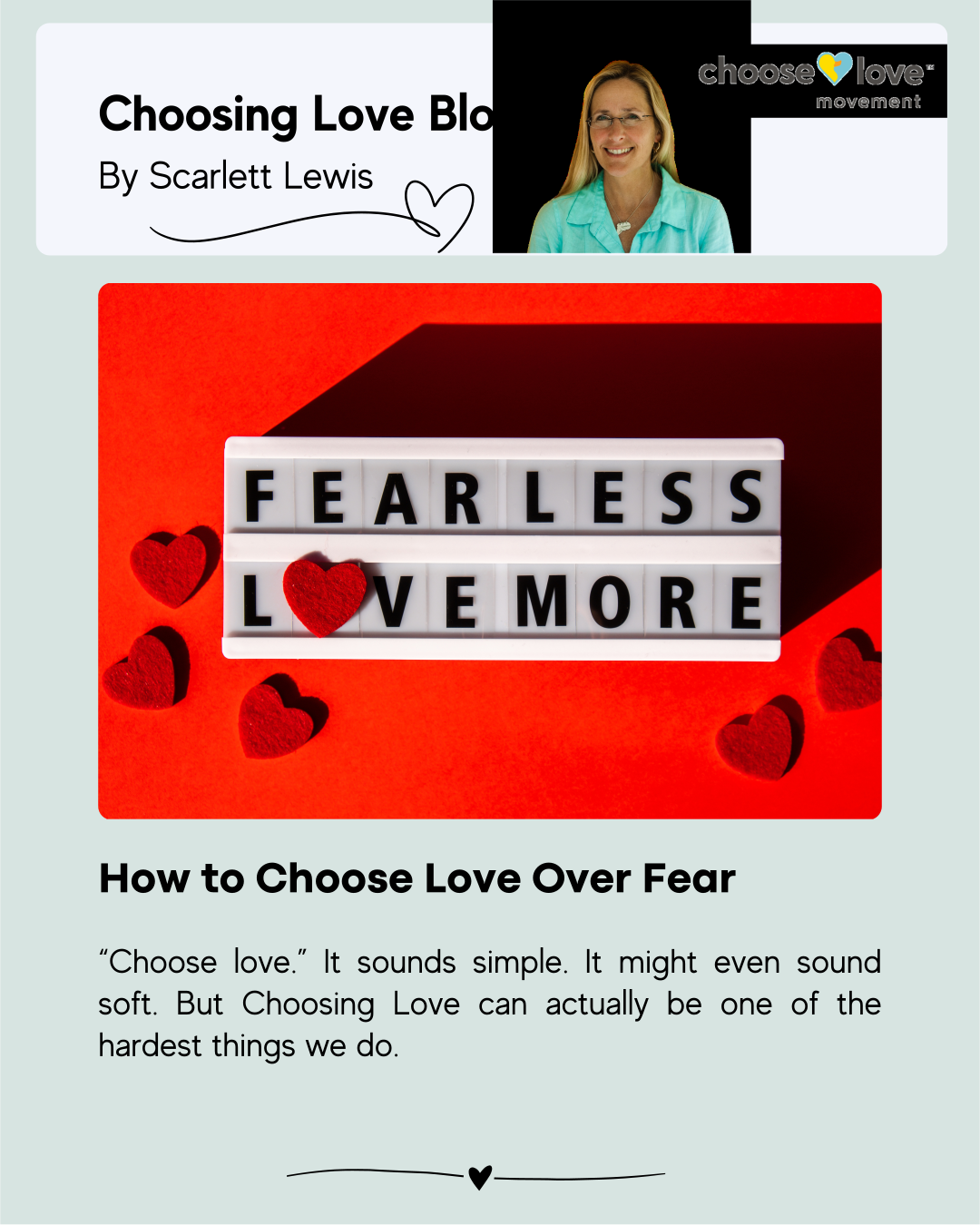
By Scarlett Lewis, Founder of the Choose Love Movement
“Choose love.” It sounds simple. It might even sound soft. But Choosing Love can actually be one of the hardest things we do. It’s easy to Choose Love when everything is going our way. The real test comes when someone hurts us, when we’re angry or afraid, when our child is struggling, when a colleague challenges us, when we feel rejected or disrespected, or when life suddenly doesn’t look anything like we thought it would. Those are the moments when Choosing Love matters most, and they’re also the moments when fear can take over.
Fear is part of being human. It has an important job: to protect us. Our brains are constantly scanning our environment for potential threats, and when one is detected, our bodies prepare us to protect ourselves. That response can save our lives when we’re in actual danger. But our brains can also respond strongly to emotional and social threats. Rejection, criticism, uncertainty, embarrassment, conflict and loss can put us into a reactive state even when we aren’t in physical danger.
And fear doesn’t always look like fear. Sometimes fear looks like anger. Sometimes it looks like control, defensiveness, avoidance, blame, resentment, jealousy, shutting down, lashing out or needing to be right. Sometimes it looks like scrolling on our phones, watching another show or finding anything else to do because we don’t want to face the difficult thing in front of us. That’s why learning to recognize fear in all of its forms is so important.
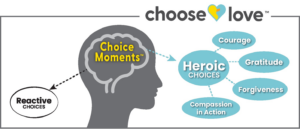
One of the most powerful things I’ve learned is that we don’t have to act on our first reaction. There is a space between what happens to us and what we do next. At Choose Love, we call this the Choice Moment. Something happens. We have thoughts, feelings and physical reactions. Then, even if the space is very small, there is an opportunity to pause and ask, “How do I want to respond?” That pause can move us from automatic reaction to conscious choice.
Sometimes the first step is simply taking a breath.
Slow down. Allow your body to settle. Notice what’s happening inside you without immediately acting on it. Then get curious. What am I feeling? What am I afraid of? What story am I telling myself about what just happened? Is that story necessarily true? What is within my control? And perhaps most importantly, what would the highest and best version of me do next?
I love that question because it gives our power back to us. Choosing Love doesn’t mean ignoring our feelings, pretending everything is okay or allowing someone to mistreat us. Sometimes Choosing Love means saying no. Sometimes it means setting a boundary or walking away. Sometimes it means having the difficult conversation we’ve been avoiding. Sometimes it means standing up for ourselves or someone else. Sometimes it means forgiving. Love isn’t weakness. Choosing Love often requires tremendous strength.
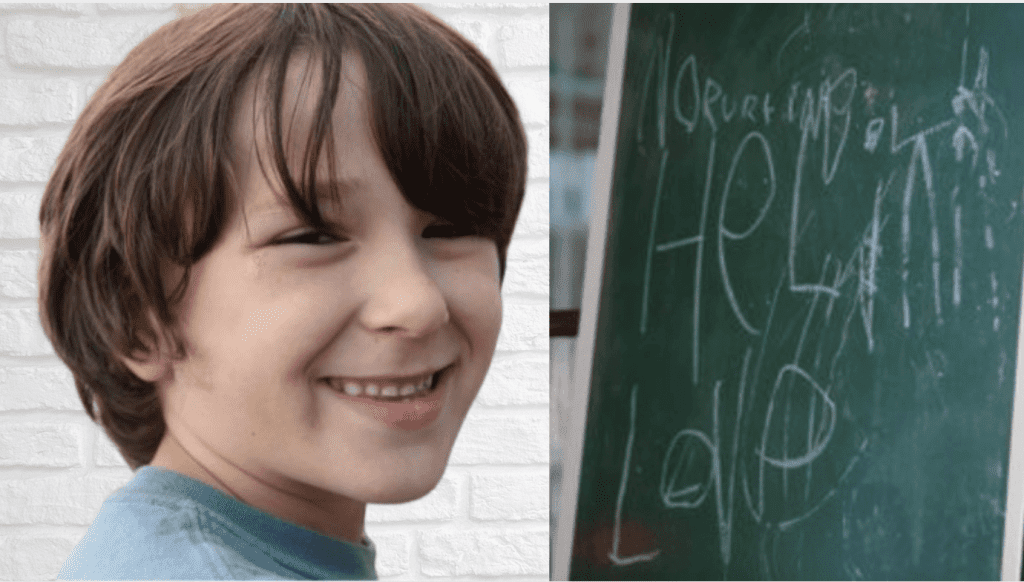
Jesse Lewis and the message he left, “Nurturing Healing Love.”
After my six-year-old son Jesse was murdered at Sandy Hook Elementary School, I discovered a message he had written on our kitchen chalkboard shortly before he died: “Nurturing Healing Love.” Those three words ultimately led me to the four character values I now call the Choose Love Formula: Courage + Gratitude + Forgiveness + Compassion-in-Action = Choosing Love. These aren’t abstract concepts. They are practical tools we can use when fear shows up in our lives.
Courage helps us face what is difficult instead of instinctively avoiding it. Fear says, “Run from this.” Courage says, “I can face this.” That doesn’t mean we aren’t afraid. Courage means moving forward even when we are. Every time we face a difficult conversation, acknowledge a painful truth, ask for help, admit a mistake or do something uncomfortable because we know it’s right, we’re practicing courage.
Gratitude helps broaden our perspective. It doesn’t ask us to be grateful for something painful or terrible that happened. Instead, it reminds us that even when something is wrong, not everything is wrong. Fear can narrow our attention until the problem is all we can see. Gratitude helps us notice what remains good, who is still standing beside us and what resources and possibilities are still available to us. It doesn’t erase pain; it allows something else to exist alongside it.
Forgiveness helps us release the thoughts and emotions that can keep us tethered to pain. Forgiveness doesn’t mean what happened was okay, nor does it eliminate accountability. It means deciding that what happened to us does not have to control what happens inside us forever. Forgiveness can be incredibly difficult, which is exactly why it can be so powerful. It is something we do for ourselves so that we can move forward.
And then there is Compassion-in-Action. This is where love becomes something we actually do. We can ask, “What action can I take to help myself? What can I do for another person? What can I do for my classroom, family, workplace or community?” Compassion without action is a feeling. Compassion-in-Action transforms that feeling into positive change.

Think about an educator whose student speaks disrespectfully to her in front of the class. Her immediate reaction might be anger: “How dare he speak to me like that?” That’s human. But there is a Choice Moment. She can pause and breathe. Courage can help her address the behavior rather than react from anger. Gratitude can remind her that this student is more than this one behavior. Forgiveness can help her avoid carrying the interaction through the rest of her day. Compassion-in-Action can allow her to hold the student accountable while also becoming curious about what might be underneath the behavior. Choosing Love doesn’t mean there are no consequences. It can change how we respond and deliver them.
The same process can happen when a teenager slams a door and says something hurtful to a parent, when a student discovers that friends have excluded her from a group chat, or when an adult receives an email that feels insulting. The circumstances change, but the opportunity is the same: pause, notice, breathe, get curious and choose. This is the practice of Choosing Love.
Our choices don’t end with us. Fear is contagious.
An angry response can provoke another angry response. Fear can create defensiveness, which creates more fear, which creates more defensiveness. We see these cycles everywhere, in families, classrooms, workplaces, communities, social media and throughout our world. But love is contagious, too. One person can interrupt the cycle by deciding, “It stops with me.”
I don’t have to return anger with anger. I don’t have to return humiliation with humiliation. I don’t have to allow another person’s behavior to determine mine. That is personal power. And when children see adults practicing this, we’re teaching something far more powerful than anything we could put on a worksheet. We’re showing them how to be human when being human is hard.
Choosing Love isn’t something we decide to do once and then master forever. We choose it over and over again, sometimes dozens of times before lunch! And we won’t always get it right. I certainly don’t. The point isn’t perfection. The point is practice. Life is an incredible classroom, and every difficult person, frustrating situation, disappointment, disagreement, loss and challenge gives us another opportunity to practice.
We often instinctively resist pain and adversity, but what if we became curious about them instead? Rather than only asking, “Why is this happening to me?” We can also ask, “What can this teach me? How can I grow through this? Who do I want to become because of this?” Difficult experiences can contain lessons, growth and even gifts, but we have to have the courage to face them in order to discover what they might be.
We look at the problems in our schools, families, communities and world and sometimes wonder how any one person could possibly make a difference. My answer is to start small. Start with the next interaction. The next difficult conversation. The next time someone pushes your buttons. The next time fear tells you to react.
Notice your Choice Moment. Pause. Breathe. Get curious. Ask yourself, “What would the highest and best version of me do right now?” Then have the courage to make that choice.
That’s Choosing Love. And imagine what could happen if millions of us practiced it together. We don’t have to wait for someone else to create a safer, kinder and more loving world. We create it ourselves, one Choice Moment at a time.